In today’s Sweden, many people associate “Midsummer” with the bright June evening when we dance around the maypole, eat pickled herring, and celebrate the summer. It’s a beautiful and living tradition – but it is not the same as the old Norse midsummer. In the pre-Christian calendar, the midpoints of the year didn’t fall on the solstices, but in the middle of each half-year. And that’s where the difference begins.
In earlier times, the year was divided into two semiyears: the Summer semi-year and Winter semi-year. Summer began roughly around what we now call April, and winter around September or October. These seasonal shifts were marked by celebrations such as Winter Nights and the Victory Blót. But the midpoints of these halves were also important. Midwinter – the true midwinter – was celebrated in January or February, when winter was at its deepest. In the same way, midsummer fell in the middle of the Summer semi-year – in July, when nature was in full bloom, the fields began to ripen, and life was abundant.
When Christianity came to the North, this way of dividing the year remained for a long time. It wasn’t until the calendar reform of the 18th century that midsummer was moved to today’s date in June, aligned with the summer solstice – the sun’s highest point in the sky. A new term was even coined for it: “the midsummer solstice.” It became practical to tie festivals to the movement of the sun rather than the rhythm of the semi-years, especially within the Christian liturgical calendar. At the same time, the winter solstice in December began to be called “midwinter,” and likewise a new word was made up: “the midwinter solstice.”
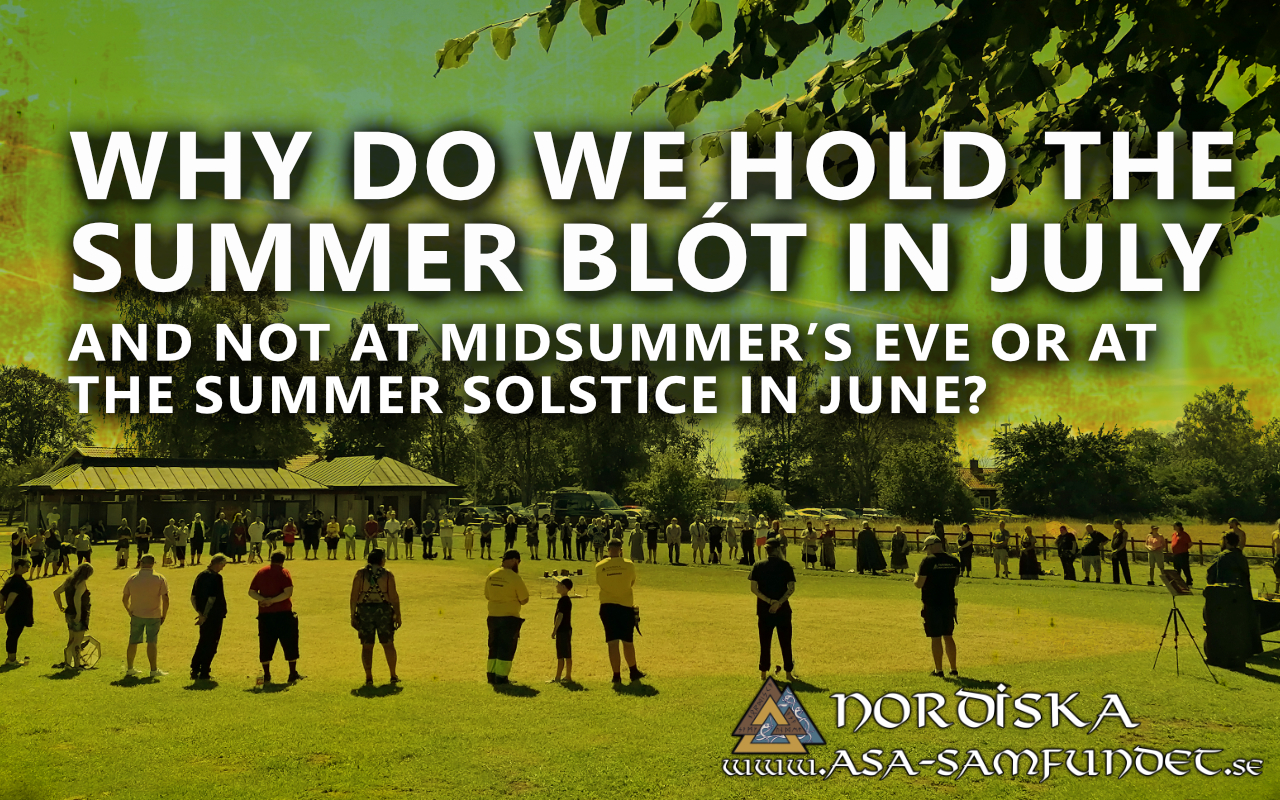
At the Nordic Asa-Community, we seek to reconnect with the older way of understanding the year. We celebrate the Summer Blót in July, to follow the old Norse tradition of when it is truly midsummer. Our blótcalendar follows the pre-Christian lunisolar calendar, where both the sun and the moon play important roles – just as in many pre-Christian cultures. This means our blóts are held at on a specific full moon, keeping us in tune with the cycles of nature and the seasons.
But – you might wonder – did they really hold a midsummer blót back then?
It’s hard to say. There are no clear sources showing that midsummer (in July) was a recurring festival in the same way as midwinter. The midwinter blót – often referred to as the heathen Yule – is mentioned in several sagas and accounts, as are Winter Nights and the Victory Blót. Midsummer is not as frequently mentioned in that context.
Still, some scholars have raised the idea that since midwinter was celebrated with a blót at the midpoint of the half-year, it may have been similar at midsummer. The rhythm of the year was built on balance – light and dark, growth and rest. There’s also a story about a Christian king in Norway who once asked some heathen farmers to show how a blót was performed, and this is said to have taken place during the summer. But we don’t know whether it was around midsummer (July), the summer solstice (June), or if it was even tied to a fixed feast – it might simply have happened then by coincidence. So it is not confirmed that a specific Summer Blót occurred in the same way as other well-attested blóts.
Even so, the Summer Blót in July is for us an important time to hold ritual. It is a time when we feel the strength of nature, when warmth, growth, and community reach their peak. By holding the blót right then – in the heart of summer’s life – we connect with ancient ways of thinking about the passage of the year, while also creating a living tradition in our own time.
And that is why we invite all of you to attend the Summer Blót.
We live in a time when much is dissolving, when everything must be new, fast, and ever-changing – and that is when we need something firm, something deep, something real. The Summer Blót is an expression of just that: a powerful act in which we unite old and new, in which we live our faith in harmony with the seasons, with nature, and with our Nordic heritage.
Join us. Be part of the renewal. Help carry our traditions into the future.
/ Nordic Asa-community