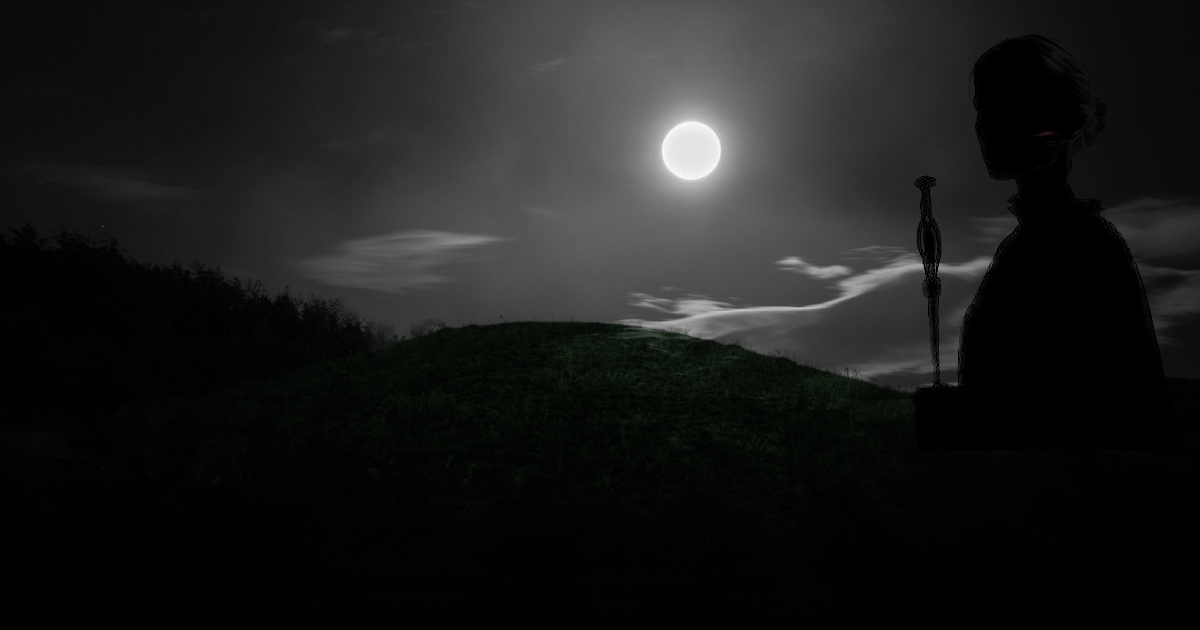
Sitting out (Old Norse: útiseta) was a spiritual practice in the Old Norse tradition where a person would sit alone in nature, often at a power place such as a burial mound, mountaintop, or near a spring, to seek visions, insights, or contact with gods, spirits, and ancestors. It was used for divination, understanding one’s otlog (fate), and receiving messages from the dead. This practice was so established that it was prohibited by Icelandic law under the influence of Christianity, suggesting its earlier significance.
In the Old Norse Tradition
Sources such as Grágás, The Saga of the Sworn Brothers, Saga of Erik the Red, and Haraldskvæði describe sitting outdoors as a method for achieving clairvoyance and communicating with the supernatural. In The Saga of the Sworn Brothers, two men sit outside all night to understand their orlog (fate), and in Haraldskvæði, a person is described as reaching deeper insights through the words of seidr. The Saga of Erik the Red tells of the volva Þorbjorg lítilvölva, who through rituals and song achieves visions, which bear similarities to sitting out.
The purpose of sitting out varied – it could involve divination, contact with gods, goddesses, various spirits, and ancestors, magical visions through seidr, or self-reflection. The practice often took place at night, in special places considered sacred, and could involve fasting, silence, or ritual actions to open the mind.
Today, sitting outdoors has been revived within Ásatrú and other heathen traditions, where it is used for meditation, contact with nature, and spiritual experiences. Places such as burial mounds, forests, and sacred springs are still considered powerful, and some combine sitting outd with song, such as the Old Norse varðlokur, to enhance the connection with the supernatural. The practice can be a way to gain deeper understanding of both oneself and the ancient powers.
About sitting out according to historical sources and evidence.
Several Old Norse sources mention sitting out, either directly or in contexts that imply its function and significance. Sitting out, often associated with ritual actions or ceremonies, was seen as an important part of the Norse people’s religious and social practices. The phenomenon can be interpreted as a form of spiritual isolation or a way to prepare for communication with gods or spirits.
Several Old Norse sources mention sitting out, such as Grágás, The Saga of the Sworn Brothers, Haraldskvæði, and Saga of Erik the Red, where it is often linked to seidr and clairvoyance. Another example of sitting out in the sources appears in Saga of the Volsungs, where the main character Sigurd must undergo a form of ritual isolation to obtain the wisdom he seeks. This can be seen as a parallel to sitting out as a form of preparation for a greater spiritual awakening or to gain access to deeper insights.
In Hávamál, several texts speak about the need for solitude or isolation to connect with the divine. Another source is the Poetic Edda, where gods and heroes often seek solitude or isolation to undergo trials, receive visions, or strengthen their spiritual power. Sitting out can be seen as part of these ritual processes where the individual isolates themselves from the world to gain insights or reach a higher state of consciousness.
Here is a selection of the sources where sitting out appears in one way or another:
1. Gray Goose Laws (Grágás, Konungsbók) – Law prohibition of sitting out
The Icelandic legal text Grágás from the 13th century explicitly prohibits sitting out and links it to sorcery:
Old Norse version:
“Ef maðr sitr úti at vekja tröll upp eðr at fremja heiðni, þá er hann útlagr.”
English translation:
“If a man sits outside to awaken trolls or perform heathen rites, he is outlawed.”
This shows that sitting out was a well-known practice, but during Christianity, it was considered dangerous and prohibited.
2. The Saga of the Sworn Brothers (Fóstbræðra saga) – Sitting out to understand one’s orlog (fate)
In The Saga of the Sworn Brothers, there is a direct reference to sitting out as a method to gain insight into one’s orlog (fate):
Old Norse version:
“Þeir sátu úti um nóttina og vildi vita sitt ørlǫg.“
English translation:
“They sat outside during the night and wanted to know their fate.”
This suggests that people believed sitting out could give a deeper understanding of the course of life and future events.
3. Haraldskvæði (Hrafnsmál) – Sitting out in connection with seidr
In Haraldskvæði (also called Hrafnsmál), a poem attributed to the skald Þorbjörn Hornklofi (9th century), it is described how a person sits outside in solitude and reflects on the words of seidr:
Old Norse Version:
Sat ek úti allar nætr, hugða ek at seiðmálum.“
English Translation:
“I sat outside all nights, thinking about the words of seidr.”
This shows a connection between sitting out and seidr, indicating it could be a method for reaching altered states of consciousness and contact with the supernatural.
4. The Saga of Erik the Red (Eiríks saga rauða) – Seidr and visions
In Saga of Erik the Red, the volva Þorbjörg lítilvölva and her ability to gain visions through rituals are described. Although the word útiseta is not used, her method is reminiscent of sitting out:
Old Norse version:
“En um kveldit var henni veittur góður fagnaðr, sem siðr var til við slíka konur. Var henni búinn hásæti, og varð hún þar um nóttina. En um morguninn, er dagr var, var henni fenginn sá útbúnaður, er hon þurfti at hafa til at fremja seiðinn. Hon bað ok konur þær, er kunnu fræði það, er til seiðsins þarf, ok Vigdísi húsfreyju, at syngja varðlokur. En er þær höfðu sungit um hríð, gekk Þorbjörg til hennar og sagði, at henni sýndist margar sýnir, þær er hon vildi segja frá.“
English translation:
“In the evening, she was given a warm welcome, as was customary for such women. A high seat was arranged for her, and she stayed there overnight. In the morning, when the day broke, she was given the equipment she needed to perform the seidr. She also asked the women who knew the required knowledge for seidr, and the housewife Vigdís, to sing the magical songs (varðlokur). And when they had sung for a while, Þorbjörg went to her and said that she had seen many visions, which she now wanted to tell about.”
This supports the idea that sitting out was a method for gaining insights through trance or meditation. Þorbjörg performed her seidr under controlled circumstances, but her approach is similar to sitting out in that she spent the night in stillness before sharing her visions.
Saga of the Volsungs (Völsunga Saga) – Wisdom and Heroism
In the Saga of the Volsungs, Sigurd undergoes a form of ritual isolation, which is part of his journey to become a hero and gain wisdom. He seeks the wisdom and knowledge that exists in the world, and part of the process involves being alone and isolated. Unfortunately, there is no specific description of sitting out in this saga in the strictest sense, but his solitude and preparations for trials resemble ritual isolation.
Old Norse version:
“Sigurðr fór á fjallið, ok þar sat hann þrjá daga ok þrjár nætur, ok var hann þar aleinn, þar til at hann sá eldingar brenna í fjöllunum. Þá féll hann í þennan stað ok kom á rúst ok þar tók hann til vápna.”
English translation:
“Sigurd went up the mountain and sat there for three days and three nights, and was alone until he saw lightning flash in the mountains. Then he fell to this place and came to a ruined city, where he took up arms.”
This passage can be interpreted as an example of Sigurd’s solitary reflections and trials before receiving visions and strength to continue his journey as a hero. His time of solitude and isolation often reflects a form of initiation, where he gains access to new knowledge and abilities.
Purpose and Practice
Sitting out had several different uses, depending on the practitioner’s needs and intentions.
1. Divination and knowledge of orlog (fate knowledge)
As the Saga of the Sworn Brothers suggests, one of the primary purposes of sitting out was to gain knowledge of one’s orlog (fate). This may have been linked to the belief that the Norns weave the threads of a person’s life, and some could catch a glimpse of this weave through visions.
2. Contact with spirits and ancestors
There are several examples in the sagas of people seeking contact with ancestors by sitting near burial mounds. In addition to the disir and fylgjor, protective spirits, other beings, such as landvættir and nature spirits, could appear to those seeking insight through sitting out.
3. Seidr and Magical Visions
The connection between sitting out and seidr is strong, especially in Haraldskvæði. Just as volvor could sit elevated on a seidr platform (such as a seat or stool) to achieve their visions, sitting outdoors can be seen as a form of spiritual elevation, a way to break through the veil separating the human world from the supernatural.
4. Self-examination and wisdom
In addition to supernatural aspects, sitting out could also have been a method for self-examination, similar to meditation. By sitting alone in silence, a person could reach deeper insights about themselves and their place in the world.
How could an sitting out have taken place?
Although the details of the actual practice are not preserved in the sources, we can make some assumptions based on the context and later traditions:
- The Place – The sitting out often took place in locations with strong spiritual significance, such as burial mounds, mountain tops, forests, or near sacred springs.
- The Timing – It seems to have been common to perform sitting out at night, when the world was believed to be more open to spiritual influences.
- The Method – The person might sit in silence, possibly fasting or performing simpler ritual actions to open their mind.
- The Purpose – Depending on the intention, the experience could range from a peaceful meditation to an intense trance-like state.
Summary:
Sitting out (útiseta) was an ancient Norse practice where a person would sit alone in nature, usually at night, to receive visions, contact the spiritual world, or gain insights into their orlog (fate). It was associated with divination, seiðr, and contact with ancestors, but was later prohibited by Christian laws. The sources suggest it was an established spiritual practice in the pre-Christian Nordic countries. The custom was banned during Christianity but has since been revived by practitioners of Ásatrú. Many modern practitioners use it for meditation, connecting with nature, or as part of spiritual rituals. Like before, places with historical or mythological significance are considered especially powerful for sitting out.
How to do a out sitting today.

Sitting out is a method for seeking visions, contact with powers, and insight into one’s orlog (fate). It is a practice that requires patience, presence, and a deep connection with the chosen place.
There are many ways how to do a out sitting today – some follow descriptions found in the sources, while others are inspired by modern spirituality and New Age practices. Here’s a suggestion based on what is found in the sources.
1. Choose the right place
The location is central to sitting out. Norse sources suggest that power sites were especially important. Some places to consider:
- Burial mounds – For contact with ancestors and insight into orlog (fate).
- Mountain tops and cliffs – For spiritual clarity and seiðr.
- Old sacrificial sites – For approaching gods and ancestors.
- Sacred springs – For visions and purification.
- Forests and heathlands – For encountering nature spirits and the spirits of the earth.
Choose a place that feels right for your purpose and where you can remain undisturbed.
2. Timing for sitting out
Several sources indicate that sitting out often took place during the night:
- At midnight – When the veil between worlds was believed to be thinnest.
- During the full moon – To enhance visions and contact with gods, goddesses, or spirits.
- During the winter half-year – Winter was often associated with wisdom and insight.
- During holidays and specific points of the year – The three major festivals: Winter Nights, Midwinter Blót, and the Victory Blót. Other points like the winter and summer solstices may also be good times.
The important thing is to choose a time when you feel in harmony with the place and yourself.
3. Preparation and intention
Before sitting down, have a clear intention. What are you seeking? Examples:
- Do you wish to receive a vision of your orlog (fate)?
- Are you seeking contact with powers, ancestors, or other beings?
- Do you need insight into an important question?
Preparations may also include:
- Purification ritual – Bathing or washing in a spring or forest stream.
- A gift – Giving a small offering to the place, such as mead, honey, or a runestone.
- Fire – Many people who do an sitting out light a fire, both for warmth and concentration.
- Meditation or seiðr-like singing – Singing varðlokur or humming a monotonous melody can help open the mind.
A varðlokur (plural: varðlokur, singular: varðlokur-ljóð) is a seiðr song or chant used to call upon gods, goddesses, or various spirits. The concept appears in Saga of Erik the Red, where the volva Þorbjörg lítilvölva asks for a varðlokur to be sung so she can perform her seiðr and receive visions. The word varðlokur can be broken down into two parts: varð meaning “watch,” “protection,” or “defense,” and lokur which can mean “unlock” or “charm.” Interpretations vary, but it can be translated as a “lock song,” “watch song,” or “protective song.” The song is believed to have had a repetitive, hypnotic nature, like a magical incantation or trance-inducing chant.
How a varðlokur Might have sounded
There are no written records of ancient Norse varðlokur, but based on other galdr´s (chants) and magical invocations in sagas, they may have been rhythmic, rhyming, and often repetitive to enhance the effect.
Here are two suggestions for varðlokur, inspired by Old Norse meter and alliteration. These can be sung or chanted slowly, preferably in a monotonous melody, while focusing on your intention.
A varðlokur to call upon spirits and psychic forces:
In Old Norse style, with alliteration and repetition to create rhythm. This varðlokur serves as a call to psychic forces and powers. The repetition creates a hypnotic effect and induces a change in consciousness.
I know, I know, spirits awaken!
See a vision, sleep no more.
Walk in darkness, walk to the mind,
Show me, show me!
A varðlokur for protection during the sitting out:
To keep unwanted spirits away and strengthen one’s own power. This varðlokur creates a protective sphere around the one singing. The words are designed to instill strength and create a bond with the earth and one’s inner power.
Stand strong, fortify the memory!
Roots rise, move my mind!
Nothing dangerous, nothing near,
Sacred earth, sacred I!
4. The sitting out Itself
- Sit comfortably, but with a straight back. Sit on the ground, a rock or a mound.
- Open your senses. Listen to the wind, feel the energy of the earth, and let the night envelop you.
- Wait patiently. Visions and insights may not come immediately. Let the place speak to you.
- Keep your focus on your intention. If your thoughts wander, bring them back to your purpose.
- Be open to signs. Animal sounds, sudden feelings, images in your mind – all may be messages.
Sitting out can be calm and meditative, but also intense and powerful. It’s important to be prepared to face both the light and the dark within yourself.
5. Conclusion and aftercare
When you feel that the sitting out is over:
- Thank the place and its spirits. A simple greeting or a small offering will suffice.
- Ground yourself. Touch the earth, eat something, or drink water to fully return to the physical world.
- Write down your experiences. Impressions may be subtle and dreamlike, but they can make sense over time.
Summary
Sitting out is a powerful method for seeking insights. By choosing an appropriate place, preparing well, and being present in the experience, you can authentically recreate this ancient practice.
Contact details or if you want to get involved
E-mail: [email protected]
Tel: +46 (0)8-519 70 720