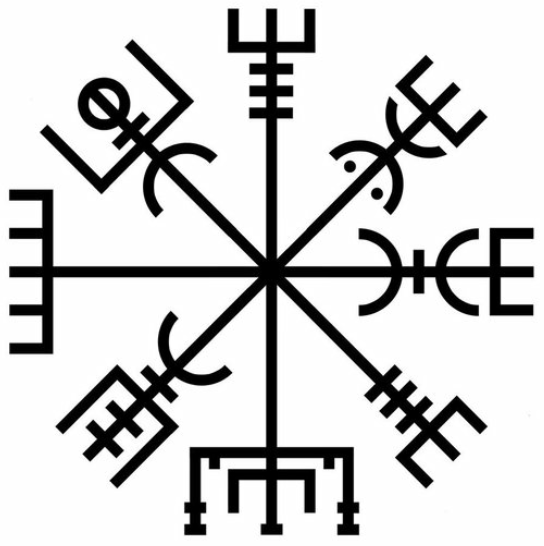
Vegvisir is included in the 19th-century Icelandic collection of galdrastaves Huld-Manuskriptet by Geir Vigfusson and in Galdraskræða Skugga by Jochum Eggertsson from 1940. According to the author, Galdraskræða Skugga contains material from earlier sources. Unfortunately, Jochum Eggertsson did not state what the sources were.
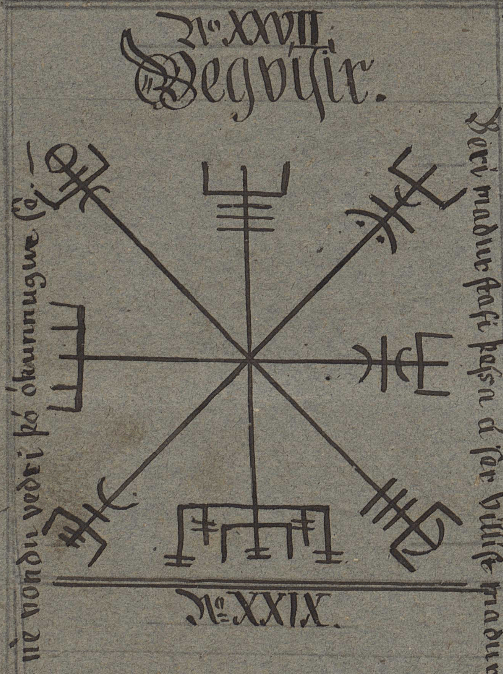
Several of the galdr´s in the Huld manuscript, which is the preliminary source for Vegvisir, are probably from pre-Christian times, while much of the rest is heavily influenced by christianity and magical practices from more southern parts of Europe. In the case of Vegvisir, there is no evidence that it was known or used in the Viking Age or earlier. Most evidence suggests that the Vegvisir dates from the time when the Huld manuscript was compiled.
The Vegvisir is often referred to as a rune or a Viking compass, as there is no source for the Vegvisir being so old it should not be considered a Norse/Viking symbol.
Despite its young age and history, the Vegvisir has become a symbol of the Norse, a symbol of Norse Heathenry.
Often you also see a ring of the Elder Futhark around the symbol, and some argue that this would somehow strengthen its power, but there is no support whatsoever that this would be authentic or somehow strengthen the power. However, from a purely artistic point of view, the symbol looks good with runes around it.
There are those who suggest that Vegvisir contains runes despite its history, it would then be runes from the Younger Futhark and the Danish medieval futhark from about the 14th century
The runes Thorn/Thurs, Gebu and Mannaz / Man / Maðr from the two mentioned rune lines are supposed to be in the symbol. We can only speculate whether Vegvisir would contain runes or not, we simply do not know.
Fen Alraun has a theory based on the fact that the symbol would contain 8 different protective spells on each stave, which as a whole make a powerful spell that protects against many different kinds of obstacles that can cause you to lose your way. He believes that it is not necessary to understand the meaning of each wand: as long as it is drawn correctly each time it will still hold its power.
The shape of the symbol in the Huld Manuscript is square, while that of Galdraskræða Skugga is designed to fit in a circle. The drawing was made for Ólafur Davíðsson. Fen Alraun writes that by making a small change such as in this case making the staves the same length, the power of the magic is affected very little. This means that Vegvisir works just as well in a circular version inside a circle. There is no change in the magic because the symbols themselves have not changed.
In which direction you point the symbol there are many theories, some say it should be reflected exactly in the direction shown in the Hulda Manuscript, but Fen Alraun has a different opinion on that matter, in that the symbol has 8 staves extending in all directions, it does not depend on up, down or any direction.
The only thing that is written in the Huld Manuscript about the Vegvisir is the following text:
“Nos. XXVII + XXIX. Vegvisir.Beri maður stafi þessa á sér villist maður ekki í hríðum né vondu veðri þó ókunnugur sá.”
Translation:
“If this sign is worn, one will never lose one’s way in storms or bad weather, even when the way is not known.”