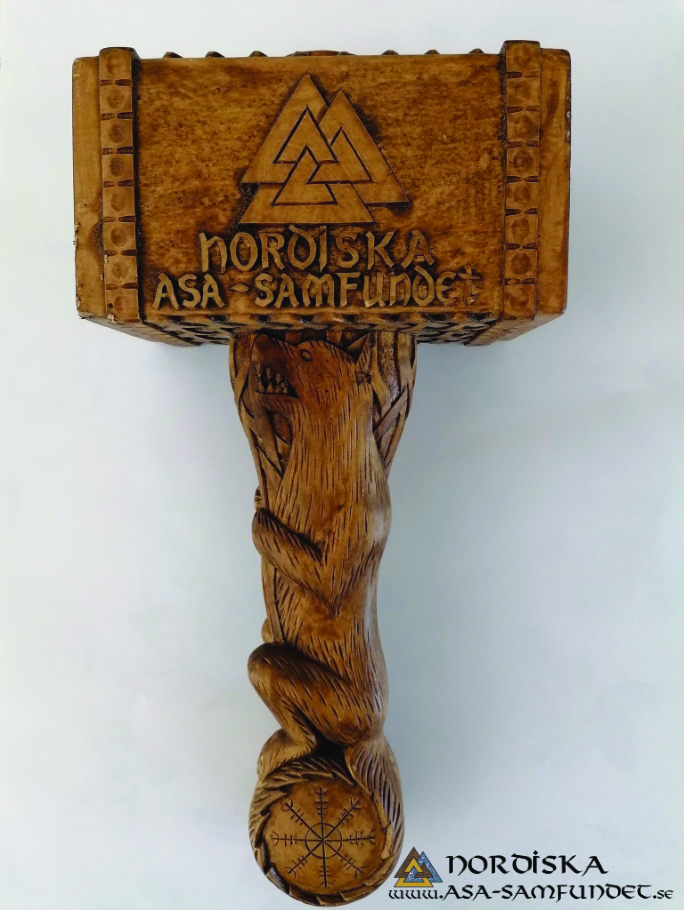
The Mjolnir, also known as Thor´s hammer, is the most well-known and popular symbol of Asatru, but not everyone who wears it is necessarily norse heathen. Many wear it for different reasons, some wear it to show their religious affiliation or because the Mjolnir gives them an inner power while others wear it to show their cultural affiliation.
The use of the Mjolnir as jewelry is very old, the hammer has been found as jewelry from the 5th century. It is believed that the reason for this was partly a backlash against the Christian religion that was beginning to spread and take hold in the Germanic regions. But as a symbol, the hammer is older than that, it is believed to have succeeded the axe, which is an older symbol of thunder and lightning. Among Bronze Age rock carvings, both the hammer and the axe appear in cultic contexts and in the hands of gods.
Mjolnir (Old West Norse: Mjǫllnir).
The name Mjolnir has several meanings, some of which are ‘crushing’ and ‘destroyer’. The Aeisir god Thor uses Mjolnir to fight the jótnar (giants) that threaten Asgard and Midgard. Thor is described as the protector of the mankind and Midgard.
Mjolnir is a very powerful hammer that always comes back to Thor’s hand, to handle the power of the hammer Thor must use special gloves called járngreipr or járnglófar.
Although Thor is the strongest Aesir, he needs the power belt Megingjord (Old West Norse: megingjǫrð) which means power belt to double his strength.
Mjolnir – In Archaeology.
The hammer is depicted on everything from Viking Age rune stones to Bronze Age rock carvings, in addition to these, many finds have been made, the oldest finds found are in England and these two Mjolnir´s date to the 5th century, the oldest in Sweden are from the 6th century.
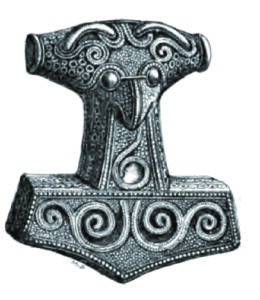
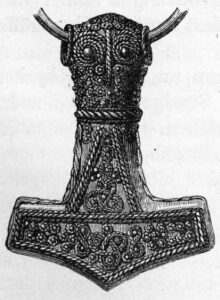
Many different designs of Mjolnir have been found, the most famous hammers are probably the so-called Skåne hammer, Ödehögs hammer, Läby hammer and Ölands hammer.
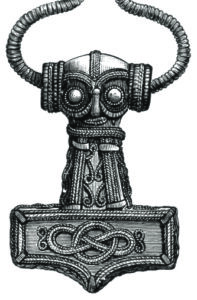
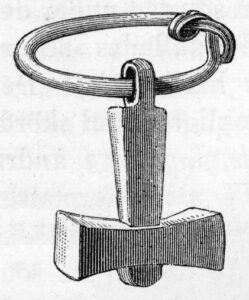
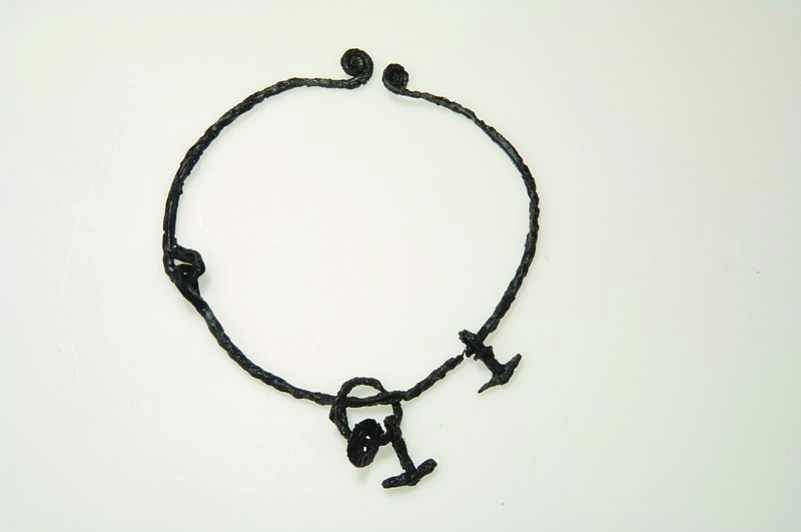
Large rings with several hammers hanging from them, so-called Thor´s hammer- rings, have also been found:
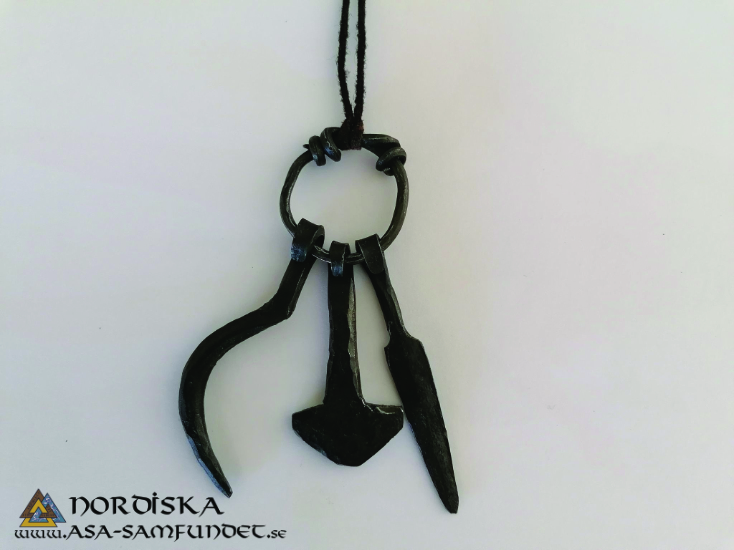
Jewelry with a hammer, spearhead and a sickle has also been found in Uppland, in Sweden and elsewhere. The hammer is linked to Thor, the spearhead (Gungnir) to Odin and the sickle to Freyr:
Mjolnir in ceremonies.
Hammers were used in various ceremonies, at weddings, funerals, and perhaps at namegiving/water pouring.
At weddings there is sometimes talk of “standing under the hammer”, “being married under the hammer” etc.
The most famous example where Mjolnir itself is used for a wedding is in The Tale of Thrym / Thrymskvida (Old West Norse: Þrymskviða) at the wedding of Thor dressed as Freyja and the jótn (giant) Thrym.
The tale of Thrym / Thrymskvida (Old West Norse: Þrymskviða):
Old West Norse:
30.
“Þá kvað þat Þrymr,
þursa dróttinn:
“Berið inn hamar
brúði at vígja,
lekkið Mjöllni
í meyjar kné,
vígið okkr saman
Várar hendi.”
Swedish:
30.
“Då sade Trym,
tursarnes drott:
“Bären hammaren in
bruden att viga!
Läggen Mjollner
i möns knä!
Vigen oss tillsammans
med Vars hand!”
The hammer may also have been used for burial, in Gylfaginning (Old West Norse: Hér hefr Gylfaginning) it is said that Thor consecrates Baldr’s pyre with Mjolnir:
Old west norse:
“Þá stóð Þórr at ok vígði bálit með Mjöllni.”
English:
“Thor stood by and consecrated the fire with Mjolnir.”
Thor’s hammer rings (ring with several hammers hanging) have been found in cremation burials, leading to the belief that these rings were used in a burial ceremony.
It is also believed that hammers were used for namegiving/ wateri pouring, as the hammer was an important ritual tool, it is not entirely unlikely.
Mjolnir in folklore.
Even though the population was Christianized, the Asatru lived on in folklore, as did Mjolnir.
In medieval Nordic folklore, thunderbolts were the names of stone axes found in the ground. In folklore, these objects were associated with the god Thor and were thought to have magical properties. It was believed that thunderbolts penetrated deep into the earth with every lightning strike and emerged from the ground after a long time. They were said to offer protection against, for example, disease, sorcery, vermin and further lightning strikes (lightning never strikes twice in the same place).
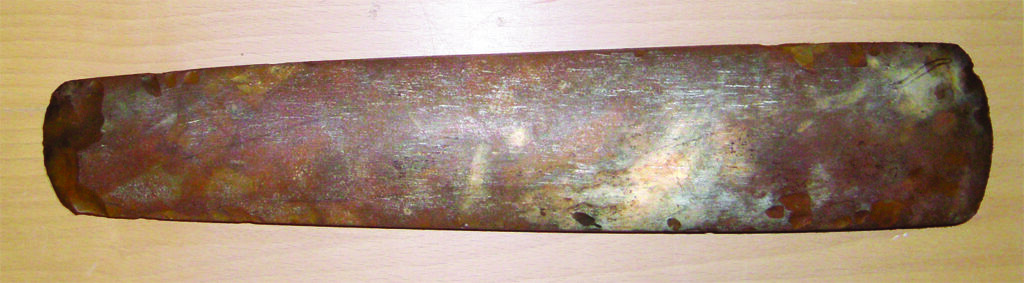
The thunderbolt also had a whole range of protective and fertility-enhancing properties. It prevented the grain from germinating, kept rats away, prevented the milk from souring and made the brew ferment. It also guaranteed good luck in hunting and fishing and, last but not least, it was an effective protection against trolls and evil forces – it could also be used in love magic.
The creation of Mjolnir.
Thor’s wife Sif was asleep when Loki snuck in to cause trouble. Without waking the goddess, he managed to cut off her long, blonde hair. It was revealed that it was Loki who was behind this atrocity. Thor then threatened Loki to crush every bone in his body unless he went to the underworld to persuade the dwarves to make new hair for Sif. The hair would be of the purest gold and grow on her head like real hair.
Loki left and sought out the sons of Ivalde to ask them to forge hair of gold. Loki, in an attempt to appease the anger of the gods, asked the sons of Ivalde to forge not only Sif’s new hair, but also the ship Skidbladnir and the spear Gungnir. As Loki set off for home with these precious items, he came across the two dwarf brothers Brokk and Sindre (also called Eitre). Loki showed them the jewels he had brought with him and bet Brokk that Sindre would not be able to create three objects of equal quality. Loki was so sure of himself that he promised his head in the bet.
The two dwarves set to work in their forge. Brokk tended the bellows and kept the fire alive, while Sindre began to forge. When Loki realized that he was in danger of losing the wager, he turned himself into a brake, trying to interfere with Brokk’s work with angry stings, but Brokk was steadfast and persevered.
Sindre first created a living boar that shimmered with gold. Then he forged the ring Draupnir. Then he began to forge a hammer. Loki, who was still transformed into a bramble, then sat on Brokk’s eyebrow and bit him so hard that blood ran down into his eye. Brokk had to let go of the bellows for a moment to wipe away the blood. When the hammer was lifted out of the fire, it turned out that the handle had become slightly too short.
Loki and Brokk went to Asgard to settle the bet. The winner of the bet would be the one whose object Odin, Thor and Freyr chose.
Sif got her new hair, Odin got the spear Gungnir and Freyr got the ship Skidbladnir. The gods were very impressed and Loki began to think he was safe. Brokk then presented his works of art and distributed them among the gods: Freyr got the boar Gullinburst, Odin got the ring Draupnir and the Thor got the hammer.
The gods deliberated for a long time, finally deciding that the hammer, despite its short shaft, was the best of the gifts, as it could provide protection against the giants’ attacks. The dwarf had won the bet.
That’s what happened when Thor got the hammer, whose name is Mjolnir.
Sources:
Snorri’s Edda – Snorri Sturlusson
The tale of Thrym / Trymskvida (Þrymskviða)
Gylfaginning (Hér hefr Gylfaginning)
Tors Hammare – Hans Hildebrand
Torshammare, Hur ska smycket tolkas? – Fredric Wirbrand
Vem är vem i Nordisk mytologi. Gestalter och äventyr i Eddans gudavärld – Åke Hultkrantz
Asa-Tors hammare, Gudar och jättar i tro och tradition – Ebbe Schön
Statens Historiska Museer
Wikipedia