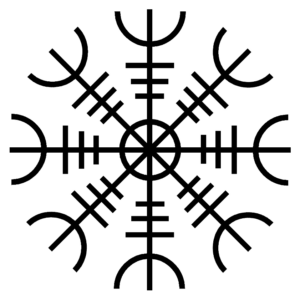
Ægishjálmr / Ægishjálmur or the Helmet of Terror, which etymologically means helmet from Ægir meaning terror. Ægir/Ägir is also the name of the God of the Sea. Usually defined as the Helmet of Terror and reference to it occurs in the Poetic Edda and in the Volsunga saga.
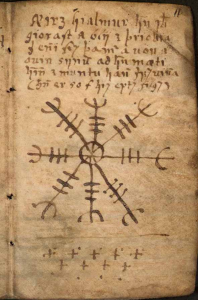
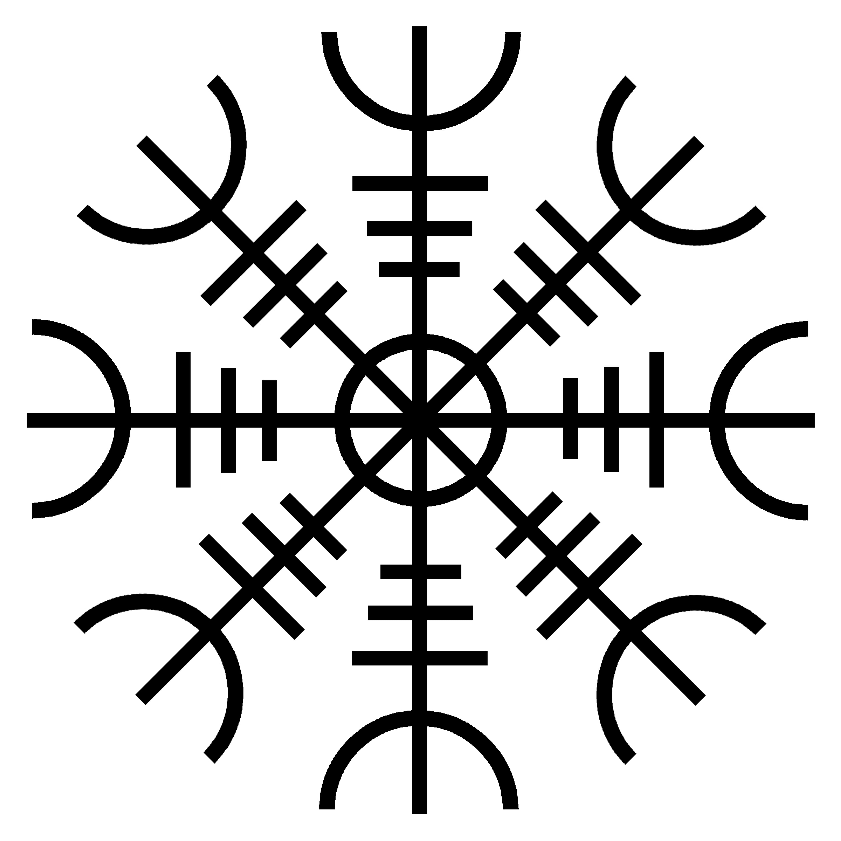
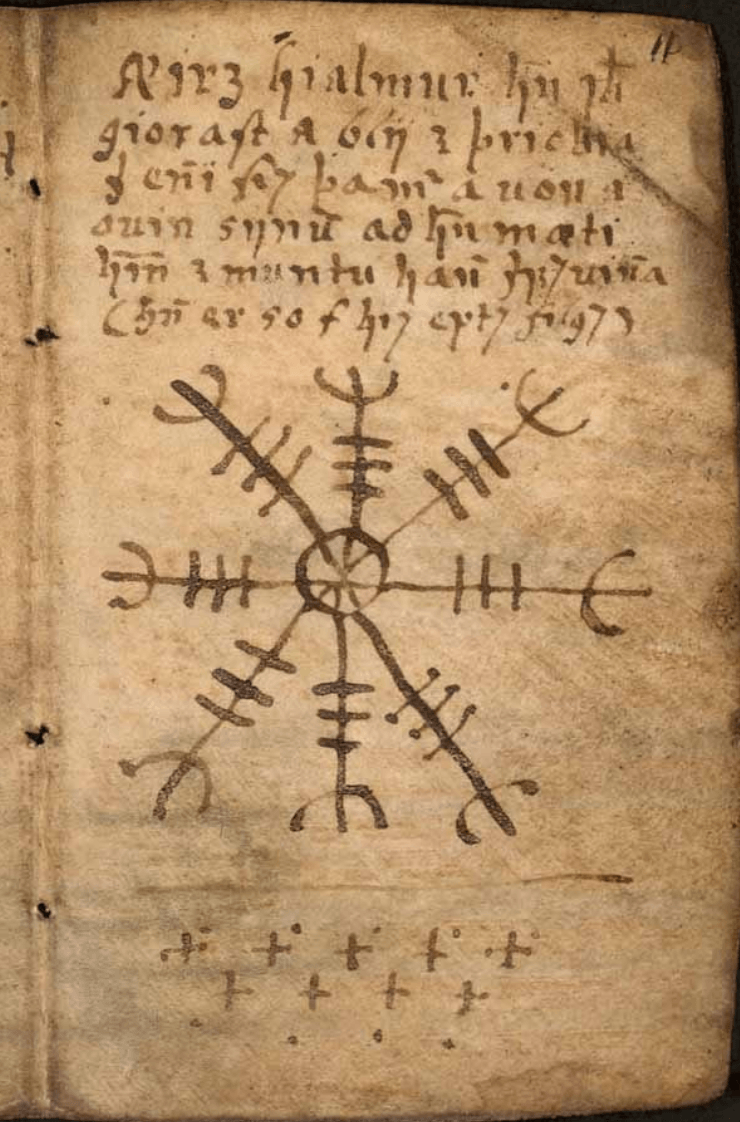
Ægishjálmr Ægishjálmur is mentioned by name in the Poetic Edda, Fàfnirsmàl and in the Volsunga Saga.
In the Poetic Edda it is mentioned as a helmet of terror, but although the word helmet appears in the name, it was most likely not a real helmet, its structure and design has no recognisable shape of a helmet, and the Edda also mentions that the object is not a helmet but rather a general covering that surrounds the wearer with a bridging power to frighten away and subdue his enemies. The effect is concentrated in or between the eyes.
From the Poetic Edda:
Fàfnirsmàl
Fáfnir kvað:
16.
Ægishjalm
bar ek of alda sonum,
meðan ek of menjum lák;
einn rammari
hugðumk öllum vera,
fannk-a ek svá marga mögu.”
Sigurðr kvað:
17.
“Ægishjalmr
bergr einungi,
hvar skulu vreiðir vega;
þá þat finnr,
er með fleirum kemr,
at engi er einna hvatastr.”
English translation,
by Benjamin Thorpe
Fafnir said:
16.
An Ægis-helm I bore
among the sons of men,
while I o’er the treasures lay;
stronger than all
I thought myself to be;
stronger I found not many!
Sigurd said:
17.
An Ægis-helm
is no protection,
where men impelled by anger fight:
soon he finds,
who among many comes,
that no one is alone the boldest.
Despite its roots in the sagas, we do not know what the actual symbol looked like. Because what Ægishjálmur looks like today is from the Icelandic manuscript Galdrabók written in the period from 1550 to 1650, which is a book of Icelandic galdras. In it, Ægishjálmur appears as a galdra staff, made up of the runes Ass/Algiz, Madr and Yr.
Ægishjálmur can range in style from very simple to very complex in design; but all have a symmetry – they all have arms usually 4 or 8 arms radiating out from the centre with through rods and end terminals which can either be circles, runes, cup shapes, lines or other mystical characters, and they are all intended to affect the wearer’s immediate area conditions for enhancement.
The power of Ægishjálmur is invoked through the use of seiðr, Ægishjálmur belongs to a seiðr magic called sjónhverfing, the magical illusion or deception of sight in which the volva affects the minds of others so that they cannot see things as they really are. In Galdrabók it says the following:
This stave must be written in your blood and with your ring finger on your right hand, making you fearless against your enemies, whoever they may be.
Some argue that the centre circle of the symbol would represent one’s soul (this is where the Old Norse view differs from the christian view, in the Old Norse there is no soul in that sense) surrounded by protective energy. Greg Crowfoot describes Ægishjálmur as having three zones: an outer ring representing the subjective universe, a middle zone (the objective universe) and a centre zone (the inner being). Robert Blumetti describes in detail that they all have the basic shape of spokes radiating outwards from a centre point:
‘They all represent the basic cosmological blueprint of Yggdrasil with nine worlds. This is especially true of the eight-spoked wheel sails. Each speaker is one of the eight worlds located in the North, South, East, West and Upper and Lower worlds. The ninth world is in the centre where all the spokes come together. This is of course Middle-earth’.
Ægishjálmur would then represent the world tree Yggdrasil, which stretches across everything and the universe. The inner circle represents the realm of humans, Midgard. This then reinforces the M-rune connection and gives rise to the idea that the outer ring of the symbol is the protection of human life. The spread of this idea over the internet has become popular, but it is probably not accurate. It is more correct and accurate to consider the Ægishjálmar as a category of galdrstaves.