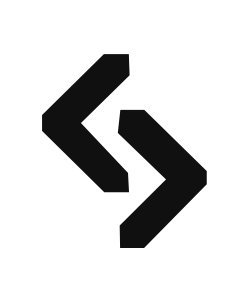
Variation on Jara.
Click on images to enlarge.
Name: Jara, Jera, Ár
Aettir: Hagal
Sound value: /j/
Usually associated with: Freyja, Frigg.
Symbolises: Annual growth, year.
Basic meaning:
Jara derives its symbolic meaning from its name which means year, annual growth.
Structure of the rune:
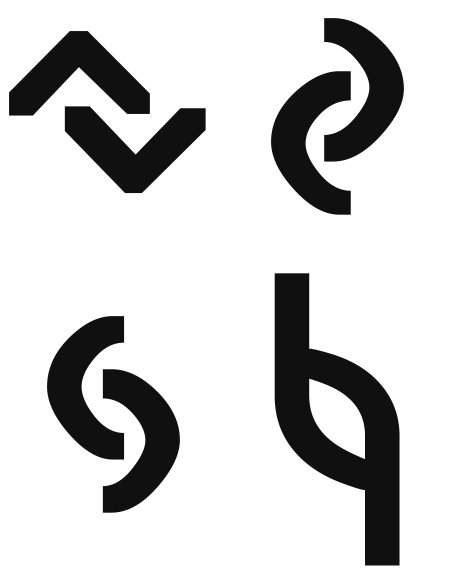
The jera consists of a total of 4 bi-staffs in two identical formations facing each other, the two bi-staffs of one formation extending from the centre of the bi-staffs of the other formation without touching each other.
The positions of the bi-staffs can vary in design.
The sound value of the rune:
In the Proto-Norse Futhark, Jara has the sound value /j/. In English, it is pronounced as a consonantal /y/, like the /y/-sound in the word York. Many people use this rune in the name Tyr, but this is completely wrong because then it is translated as: TJR and not TYR.
Rune Poems
The three rune poems.
The names and symbolism of the runes are based mainly on three poems, which are the Old Icelandic, the Old Norwegian and the Anglo-Saxon. The Old Icelandic and Old Norwegian rune poems contain only 16 poems because they belong to the Younger Futhark, while the Anglo-Saxon rune poem contains 29 poems because the Anglo-Saxon/Frisian rune line futhorc contains 29 runes. The Anglo-Saxon rune poems have then been combined with the proto-norse runes that lack Old Icelandic and Old Norwegian rune poems, which is not at all wrong because the Anglo-Saxon futhorc also has the eight runes that lack old nordic poems.
Swedish runic poems.
There is also something called the Swedish rune poems, these arise in connection with rune staves (prim staves rune calendars,), rune staves have been found from the 12th century but the use of rune staves is known from the 5th century.
We have also chosen to include the Swedish rune poems, which are 14 verses, each of which contains only one line.
These were transcribed by the runologist Johannes Bureus in the 16th century from a rune staff believed to be from the same period. We have taken a more normalised text made by Arend Quak in 1987.
Under the poem marked with ‘-’ there are representations of meanings and symbols of agricultural life. These meanings and signs are taken from when they were recorded by the early modern researcher Georg Stiernhielm.
The different interpretations, meanings and symbolisms of runes.
You can find all sorts of interpretations and meanings of runes in books and online, all these interpretations, meanings, symbolisms and assumptions are usually based on what the author himself has interpreted the meaning of each rune, based on any or all of the three poems. But each rune has only one basic meaning, which is what the rune name means.
Swedish:
År i bladhe vidast
– i.e. åhr öfwer alt godt
Old Icelandic:
Ár er gumna góði
ok gott sumar
algróinn akr.
annus allvaldr.
Old Norwegian:
Ár er gumna góðe;
get ek at o,rr var Fróðe.
Anglo-Saxon:
Ger byÞ gumena hiht, ðonne God læteþ,
halig heofones cyning, hrusan syllan
beorhte bleda beornum ond ðearfum.