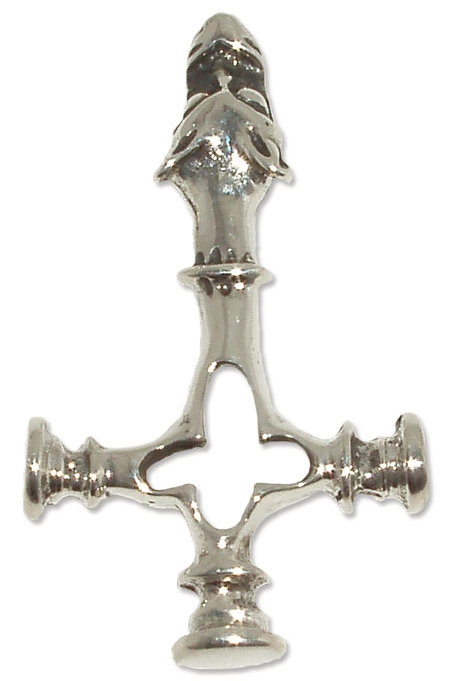
The Wolf Cross, also known as the Wolf Hammer, is a symbol that divides opinion: is it heathen or christian, or does it symbolize the coexistence of these two religions? Nobody knows, but there are many theories and interpretations about its meaning. Because of this, the Wolf Cross is used by norse heathens and christians.
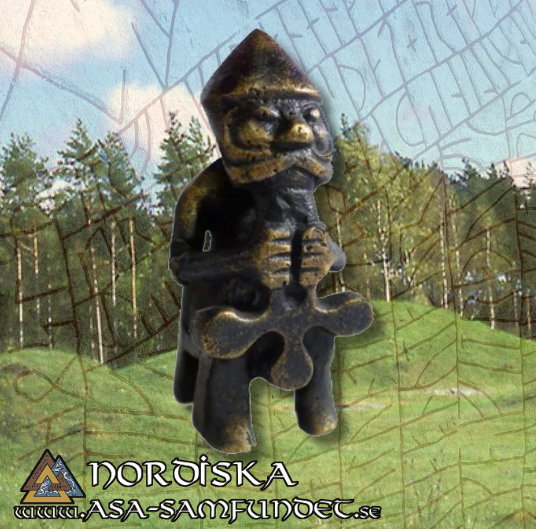
The wolf cross consists of a cross with a wolf’s head on top, the cavity in the cross is another cross. Some want to link this to the fact that it is an Irish cross, others want to link it to an Icelandic version of Mjolnir. The link to heathenry is made partly via the wolf’s head but also that the cross-like symbol is reminiscent of the Mjolnir found on an archaeological find depicting Thor, this find, like the wolf cross, was also made in Iceland.
The symbol is also reminiscent of an upside-down cross, the so-called St. Peter’s Cross, which is a christian symbol of humility. However, an upside-down cross has also been given the opposite meaning, namely that it is the symbol of the christian devil, and based on this symbolism, the wolf cross is also interpreted as a heathen symbol.
There are theories that the wolf cross is some kind of secret symbol that symbolizes Asatru.
Wolf head, bear head or lion head?
Opinions are divided on what kind of head adorns the symbol, the most common and accepted is that it is a wolf’s head but there are those who are skeptical about this.
Some want it to be a bear’s head because the archaeological find seems to resemble a lion’s head and that northerners had a negative image of the wolf. Others argue that it is a lion’s head and thus a Christian symbol. The lion’s head is linked to the story of Daniel in the lion’s den but also to Jesus.
Some who want it to be a wolf’s head link it to either Garm, the Fenris Wolf or to one of Odin’s wolves Gere or Freke.
The wolf cross in archaeology.
Only one complete wolf cross has been found, at Foss in Iceland. The find dates to the 10th century, when Iceland was inhabited by christians, which makes it even more difficult to determine whether it is heathen, christian or even a mixture of the two religions. However, similar finds have been found but these have lacked a wolf’s head, one of these finds has been made in Huse in Norway. Unlike the other headless finds, this find has a longer part of the cross, which makes it likely that there was once a head there, perhaps a wolf’s head.
Sources:
Wikipedia
Eitri
Archaeology Forum
Museum of Cultural History, Norway